
A History of Mind Readers · Part 4 of 9
Chan Canasta
Television's First Celebrity Mind Reader
9 January 1920 - 22 April 1999
Chan Canasta is one of the most quietly influential mind readers in the history of the art. He arrived on British television when the medium itself was barely a decade old, and he treated it not as a stage to be conquered but as a private room into which he had been invited. Relaxed, urbane and faintly amused, he refused the familiar billing of magician or conjurer. He preferred "psycho-magician," and later "perceptionist," because what he offered was not the supernatural but a demonstration of the powers of attention, suggestion and memory. A generation of viewers had never seen anything like him, and several generations of performers have been trying to recapture his particular spell ever since.
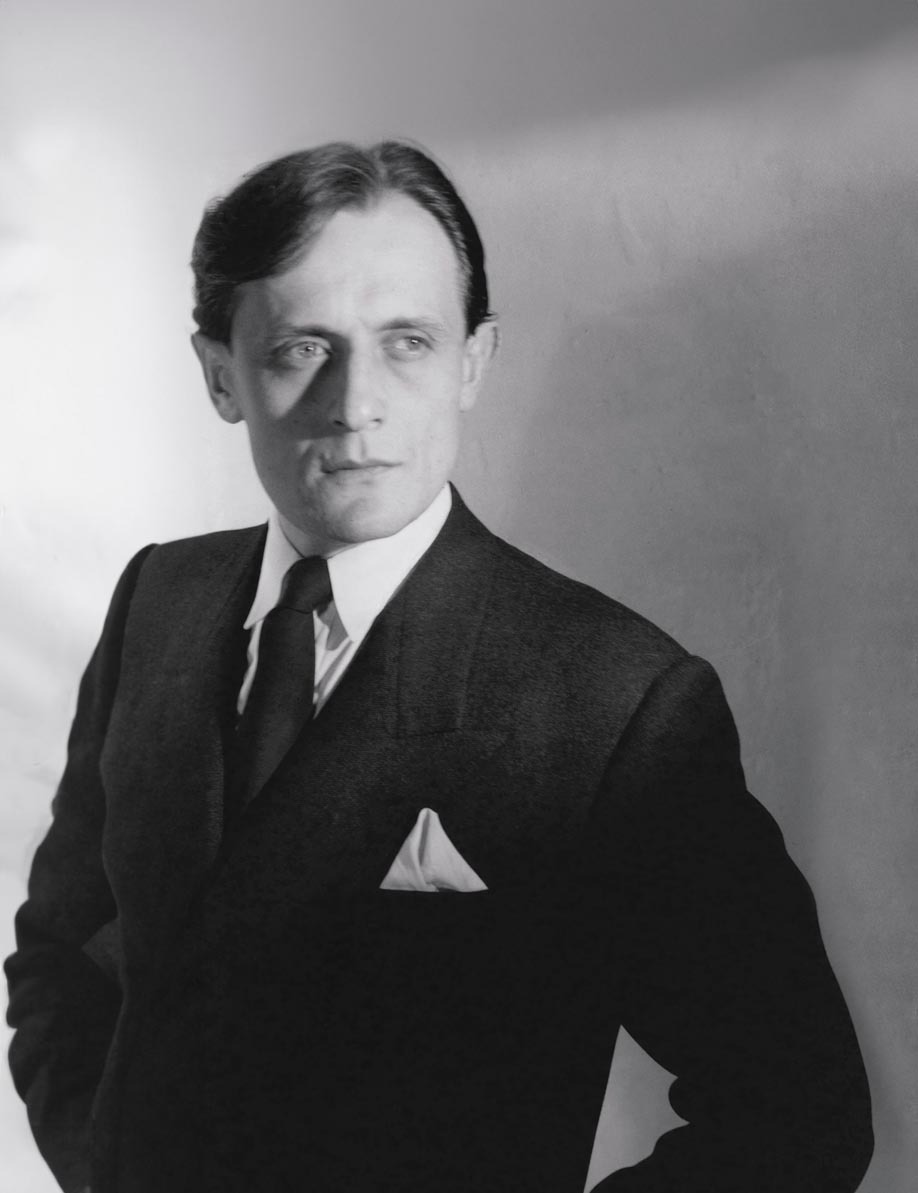
A Wartime Journey From Kraków to London
He was born Chananel Mifelew on 9 January 1920 in Kraków, the son of a Polish-Jewish educator. His was a cultured, intellectual household, and the young Mifelew read widely and travelled before the war scattered everything. He studied in Jerusalem in the late 1930s, and when conflict came he made his way to Britain and joined the Royal Air Force. The RAF years mattered. They gave him English, a circle of friends and an instinct for the kind of relaxed, conversational authority that the British warm to. They also, almost by accident, gave him a stage.
Like many servicemen he entertained his fellow airmen, and his particular trick was not the manipulation of cards but the manipulation of minds. He found he could read people: their hesitations, their tells, the small involuntary signals that betray a free choice that is not quite as free as it feels. By the time the war ended he had a name for himself, a new surname borrowed from the card game then sweeping the world, and a conviction that the most astonishing thing he could show an audience was the audience itself.
The Birth of "Psycho-Magic"
Canasta's great originality lay in framing. Conjurers of the period asked to be admired for their skill; spiritualists asked to be believed; Canasta asked only that you watch closely and draw your own conclusions. He spoke openly of psychology, probability and influence, and then proceeded to do things that no amount of psychology, probability or influence could comfortably explain. This was a deliberate and very modern strategy. By disclaiming the supernatural he made the inexplicable far more unsettling, because the spectator was left without the usual escape routes. It could not be spirits, he had told you as much; so what on earth was it?
He worked almost entirely with borrowed objects and ordinary materials: a pack of cards, a handful of banknotes, a book pulled from a shelf, a name written on a card. There were no boxes, no assistants in sequins, no apparatus. The effect was intimate and cerebral, and it played beautifully to the camera, which loves a face and distrusts a flourish.

Television's First Celebrity Mind Reader
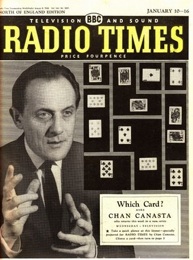
Canasta's first broadcast came in 1951, and over the following two decades he made well over three hundred and fifty appearances for the BBC, an extraordinary tally for a performer working in so specialised a field. He became a genuine household name at a time when there were few channels and a single memorable broadcast could be discussed by the entire country the next morning. Programmes built around him, with titles such as Chan Canasta's Show and the long-running Chan Canasta - A Remarkable Man, carried his billing into the language. He even featured on the cover of the Radio Times, the surest sign in mid-century Britain that a performer had truly arrived.
What made him so watchable was not novelty alone but temperament. He never hurried, never oversold, never begged for applause. He carried the slight detachment of a man conducting an interesting private experiment, and his good humour when things went his way, or occasionally did not, gave the whole enterprise the feel of a parlour game played by an unusually gifted host. Viewers did not merely watch Canasta; they felt they were sitting in the room with him.
The Experiment With Books
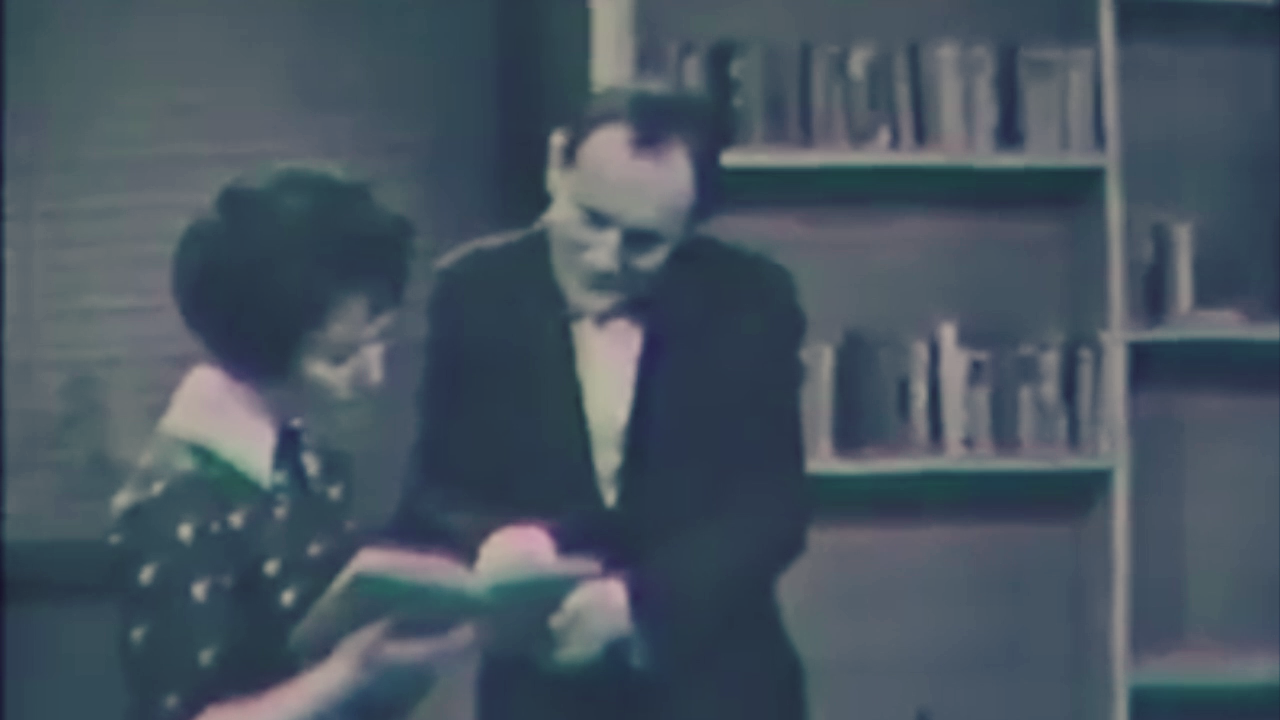
His most celebrated routine was the one he simply called an "experiment with books." A volunteer was handed a book and asked to open it at any page and read silently to themselves. Canasta, who had never seen the book and could not see the page, would then describe the scene, supply a phrase, or name the very word on which the reader's eye had settled. It is, in the language of the craft, a book test, and book tests are old; but Canasta's handling stripped away every trace of method until what remained looked like nothing less than the direct reception of another person's thoughts.
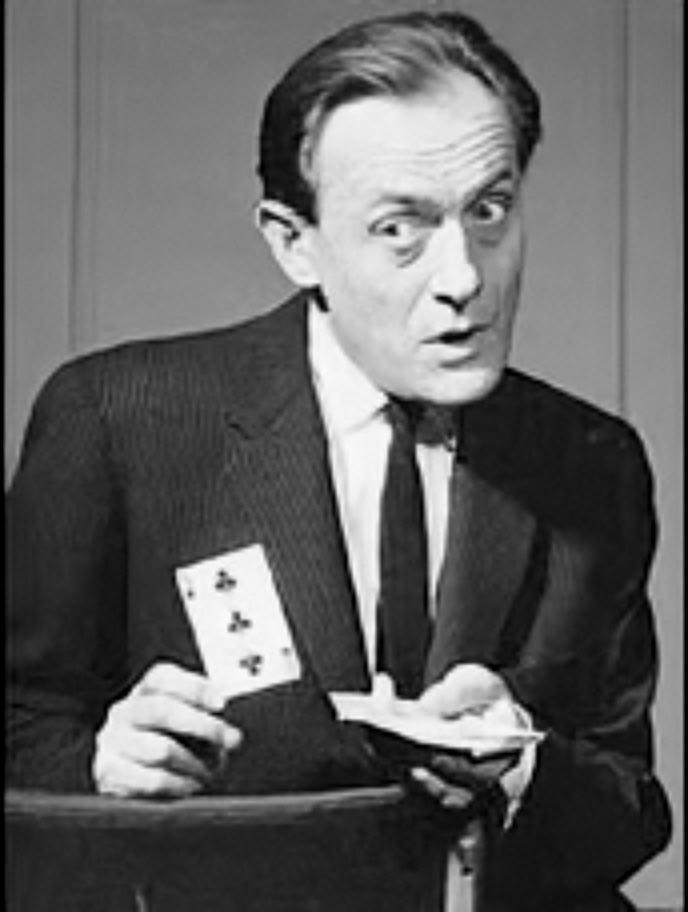
He performed comparable miracles with playing cards, asking a spectator to merely think of a card and then producing it, or predicting the order in which a shuffled pack would fall. Here too the genius was in the presentation. The mechanics, whatever they were, vanished beneath the easy talk and the apparent willingness to let chance play its part.
The Philosophy of Deliberate Imperfection
Here lies the idea for which Canasta deserves to be best remembered, and the one that most repays study by anyone who performs today. He did not insist on perfection. On occasion, by design, his experiments failed. A prediction would be wrong; a card would not match. To a conventional magician this is catastrophe, the one outcome to be prevented at any cost. Canasta understood the opposite. A performer who never fails is plainly using a trick, for tricks are certain. A performer who sometimes misses is attempting something genuinely uncertain, something that depends on perception and chance and the unrepeatable circumstances of the moment. The occasional miss was not a flaw in the act; it was the proof that there was no act at all.
"Failure makes the success more exciting."
Chan CanastaIt took great nerve, and great judgement, to build a career on a foundation that most performers spend their lives trying to eliminate. But it is precisely this acceptance of risk that lifted Canasta out of the category of clever trickster and into something closer to a genuine artist of the mind. The successes, when they came, were thrilling exactly because they might not have.
The Television Stunt That Fooled a Nation
Canasta's flair for theatre occasionally spilled beyond the studio. In one celebrated episode he announced, with apparent seriousness, that he intended to use the power of mass suggestion to influence the public on a grand scale. The resulting talk, speculation and indignation demonstrated how completely he had captured the national imagination, and how readily a calm, well-spoken man on the television could make an entire country wonder whether their own thoughts were quite their own. It was mischief of a very high order, and entirely in keeping with a performer who treated the medium as an instrument to be played.
A Second Life as an Artist
By the early 1970s Canasta had largely withdrawn from performing. A man of restless intelligence, he turned to painting, and he did so under his birth name, signing his canvases "Mifelew" rather than "Canasta." This was a quiet reclamation, the closing of a circle. His colourful landscapes, worked in crayon and chalk, were exhibited in galleries in London and New York and commanded serious prices. That a celebrated mind reader should reinvent himself as a respected painter surprised those who had only known the television figure. It would not have surprised anyone who had grasped that the performances were never really about cards or books at all, but about perception, attention and the strange machinery of the human mind, the same preoccupations that drive a painter to his easel.
Final Years
His public appearances thereafter were rare and deliberate. He returned to British screens in 1971 on Michael Parkinson's BBC show, a personal favour to a presenter who admired him, and he made one further appearance on Israeli television in 1983. Otherwise he kept his own counsel. Chan Canasta died in London on 22 April 1999, at the age of seventy-nine. He had been twice married. He left behind no school of imitators trained in his methods, for his methods were largely his own and largely unrecorded, but he left something rarer: a template for how psychological mystery might be presented to a modern audience with wit, restraint and complete conviction.
Legacy
Canasta's influence is far larger than his present fame. He proved that mind reading need not be dressed in the trappings of the séance or the sideshow, that it could be intelligent, urbane and conversational, and that television was its natural home. The line from Canasta to the psychological mentalism of today is direct and well documented. Derren Brown has repeatedly named him as a prime inspiration, and Max Maven and a generation of thinking performers worked in the territory Canasta opened. Every mentalist who now walks on stage in a plain suit, talks plainly about psychology and suggestion, and then does the impossible, is working a seam that Chan Canasta was the first to mine on television.


His own book, Chan Canasta's Book of Oopses (1966), is characteristically playful: an interactive volume in which the book itself takes the part of the mind reader, predicting and responding as the reader turns its pages. It is a small joke with a serious point buried inside, that the real mystery was always the reader's own mind. It is practically criminal that so few books have been devoted to so extraordinary a performer. But perhaps that is fitting for a man who always preferred to let the mystery speak for itself.
The original version of this article appeared in The Magic Circular, the official journal of The Magic Circle.

Original Magic Circular Article
Read the Chan Canasta feature as originally published in The Magic Circular.
Further Reading
- Britland, David. Chan Canasta: A Remarkable Man, Volume One (2000).
- Britland, David. Chan Canasta: A Remarkable Man, Volume Two (2001).
- Canasta, Chan. Chan Canasta's Book of Oopses (1966).
- Purser, Philip. "Television's first magical mystery man." The Guardian, obituary, June 1999.
Experience Mind Reading for Yourself
Roberto Forzoni carries on the tradition of these great performers, bringing psychological magic and mind reading to events across London and the world.
Check Availability