
He rigged stages with hidden wires, concealed earpieces beneath a jewelled turban, and persuaded a generation that he could read their innermost thoughts. Claude Alexander Conlin became the richest mentalist of his age and one of the most enigmatic figures in the history of magic, a man whose life held as much intrigue offstage as on it.
Alexander, billed as "The Man Who Knows," dominated the vaudeville stage of the 1910s and 1920s as the world's foremost mind reader. Yet the serene figure who answered sealed questions from a darkened auditorium was, away from the footlights, a serial bigamist, a convicted swindler, a bootlegger and a self-confessed killer with a thick FBI file. His story opens this series because it gathers, in one improbable life, every thread that would come to define modern mentalism: psychology, theatre, relentless self-promotion, and a willingness to borrow brilliance wherever he found it.
Origins and a Restless Youth
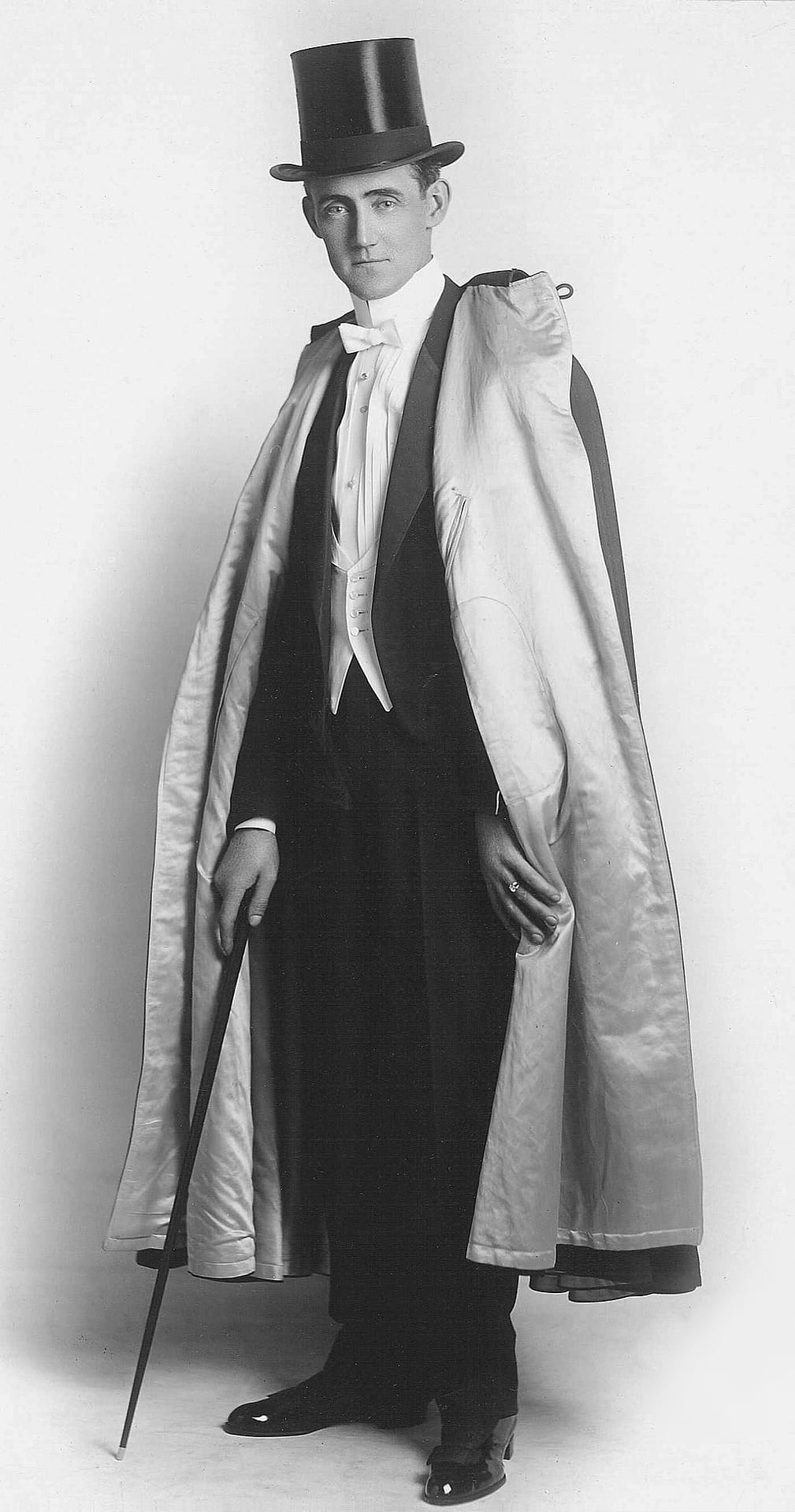
Claude Alexander Conlin was born on 30 June 1880 in the small town of Alexandria, in Hanson County in what was then the Dakota Territory and is today South Dakota. His parents were Irish immigrants; his father, Berthold Michael Joseph Conlin, was a doctor known within the family as "BMJ." Young Claude, known as "CA," had a brother, Clarence, called "CB," who would go on to a respectable career as an attorney with a sideline as a stage mentalist, though his fame never approached his brother's.
The family settled for a time in south-east Alaska, and it was there that the boy's restless character took shape. He spent his days hunting and fishing, passions that stayed with him for life, and his free hours at the local library, where he discovered Professor Hoffmann's Modern Magic, the book that lit the flame in so many performers of his generation. He was expelled from school at seventeen and, without his parents' blessing, struck out east to make his own way.
Lily Dale: The Education of a Mystic
That journey led him, almost by accident, to Lily Dale, the famous spiritualist colony near Cassadaga in New York State. Working there as a boat-boy and cleaner, Conlin received an education no school could provide. Behind the curtains he learned the entire toolkit of the fraudulent medium: the slate writing, the billet switches, the rope ties and the rest of the apparatus of the seance room. More valuable than any single trick, though, was what he absorbed about people. He saw how readily the grieving and the hopeful would supply their own belief, and how a simple deception, framed with enough conviction, could pass for a miracle. It was a lesson he never forgot.
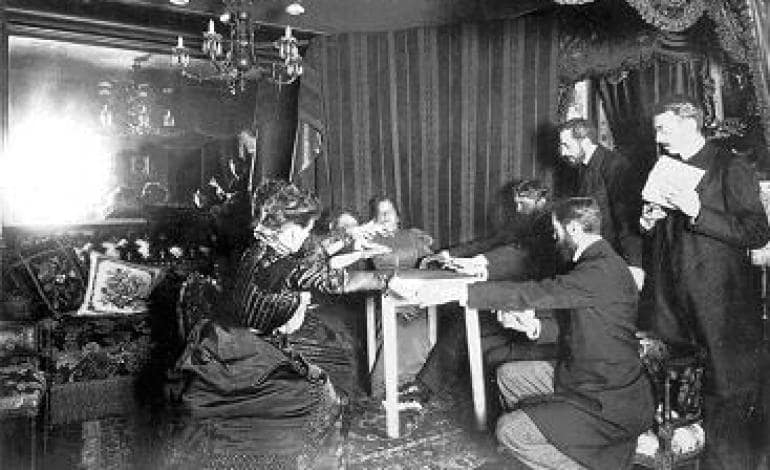
Leaving Lily Dale, he called on T Nelson Downs, the celebrated "King of Coins," before his wanderlust carried him west.
The Gold Rush, Pantages and "Soapy" Smith
The Alaskan gold rush drew him north, and it was there that he formed a lifelong friendship with the Greek immigrant Alexander Pericles Pantages, later one of the great theatre owners of America. The episode also produced the first of the dark legends that cling to his name: Conlin was suspected of shooting the notorious confidence man Jefferson Randolph "Soapy" Smith, said to have been threatening Pantages. Whether the story is true or simply an early piece of myth-making, much of it of his own manufacture, has never been settled, and that ambiguity suited him perfectly.
In these years he turned his hand to whatever paid: faro dealer, gold assayer, cashier, and, tellingly, psychic, telling hopeful prospectors where their fortunes lay buried. He gave his first stage performance in 1898, but it was not until he returned to Seattle in 1902 that he committed to magic as a career, taking the billing "Alexander the Great" after his friend Pantages and working the vaudeville circuit as a stage illusionist. His personal life was already a tangle. He married the first of his many wives, Jessie Cullen, in 1902 and divorced her the following year, all the while trying to build an escape act to rival the young Houdini.
The Turning Point: Earthquake and Blizzard
Fate, which Alexander would later claim to command, intervened twice in quick succession. A chance early-morning summons drew him from his San Francisco hotel moments before the 1906 earthquake reduced it to rubble. Then, more consequentially, a blizzard stranded the trains carrying his heavy stage illusions. With no apparatus and a show to give, an assistant suggested he simply perform his short mind-reading set as the main attraction. The propless act was a revelation, and the response astonished even him.
Now in his mid-thirties, Alexander discarded the cabinets and rebuilt his entire performance around a single, irresistible idea: that one man, alone on a stage, could know what every stranger in the room was thinking. Sensing opportunity, he returned to San Francisco to work as a psychic, knowing the earthquake had left a city full of the bereaved seeking word from the dead.
"The Man Who Knows": Building the Persona
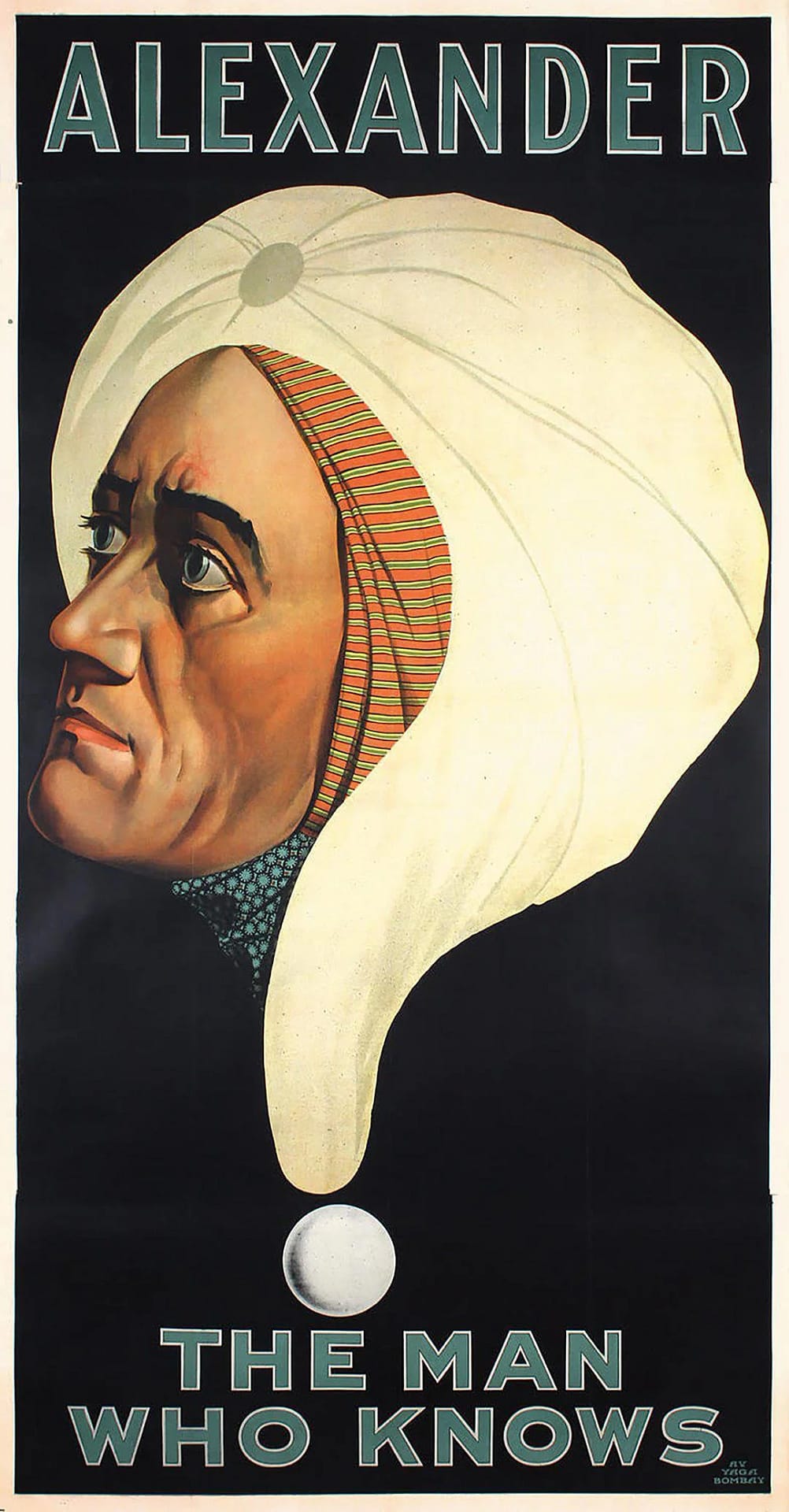
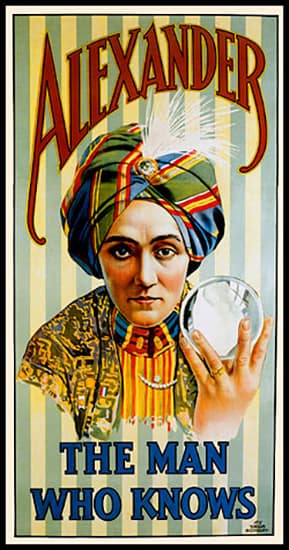
To frame this new power, Conlin built one of the most recognisable personas in show business. He appeared in a jewelled, feathered turban and flowing robes, a crystal ball at his side, the whole presented in a lavish, quasi-Oriental setting with a troupe of female assistants. The act owed an open debt to earlier performers, above all Anna Eva Fay and Samri Baldwin, whose methods he studied and adapted without apology. He had married his third wife, the seventeen-year-old Della Martell, in 1907, and during their partnership he gave private psychic readings under the name "Astro," a sideline that often earned him more than the stage itself. An earlier billing, "Alexander the Crystal Seer," gave way at last to the one that made him immortal: "Alexander, The Man Who Knows." In 1915 he married Lillian Marion, who became an integral part of the show and remained with him for some fourteen years.
Inside the Act
The centrepiece was a question-and-answer routine. Audience members wrote sealed questions about their health, their fortunes, their romances and their lost loved ones, which Alexander then answered, one after another, from the stage. Admirers of Derren Brown will recognise the lineage at once. Around this he wove a full evening of straight magic to add colour and contrast: the nest of boxes, the vanishing cane, the levitation illusion Asrah and the Cabinet Box among them. One of his favourites was Spirit Painting, in which a portrait would mysteriously appear, and which doubled, with characteristic cunning, as a revenue stream. Local politicians, doctors and dignitaries, forbidden to advertise openly, would quietly pay to have their likeness materialise in every performance.
The Method: Psychology and Hidden Wires
How did he do it? In part through the cold-reading psychology he had studied at Lily Dale. In larger part, for the headline effects, through technology years ahead of its time. Alexander is credited as a genuine pioneer of concealed electronic stage effects: he ran wires beneath the boards, hid receivers and earpieces inside his turban, and is said to have placed listening devices in theatre lavatories, so that confidences overheard before the show could be returned to their owners later as miracles. For all his command on stage, he was a martyr to his nerves before each performance, forever fearful that the electronics would betray him, a very human anxiety behind the omniscient mask.
A Genius for Marketing
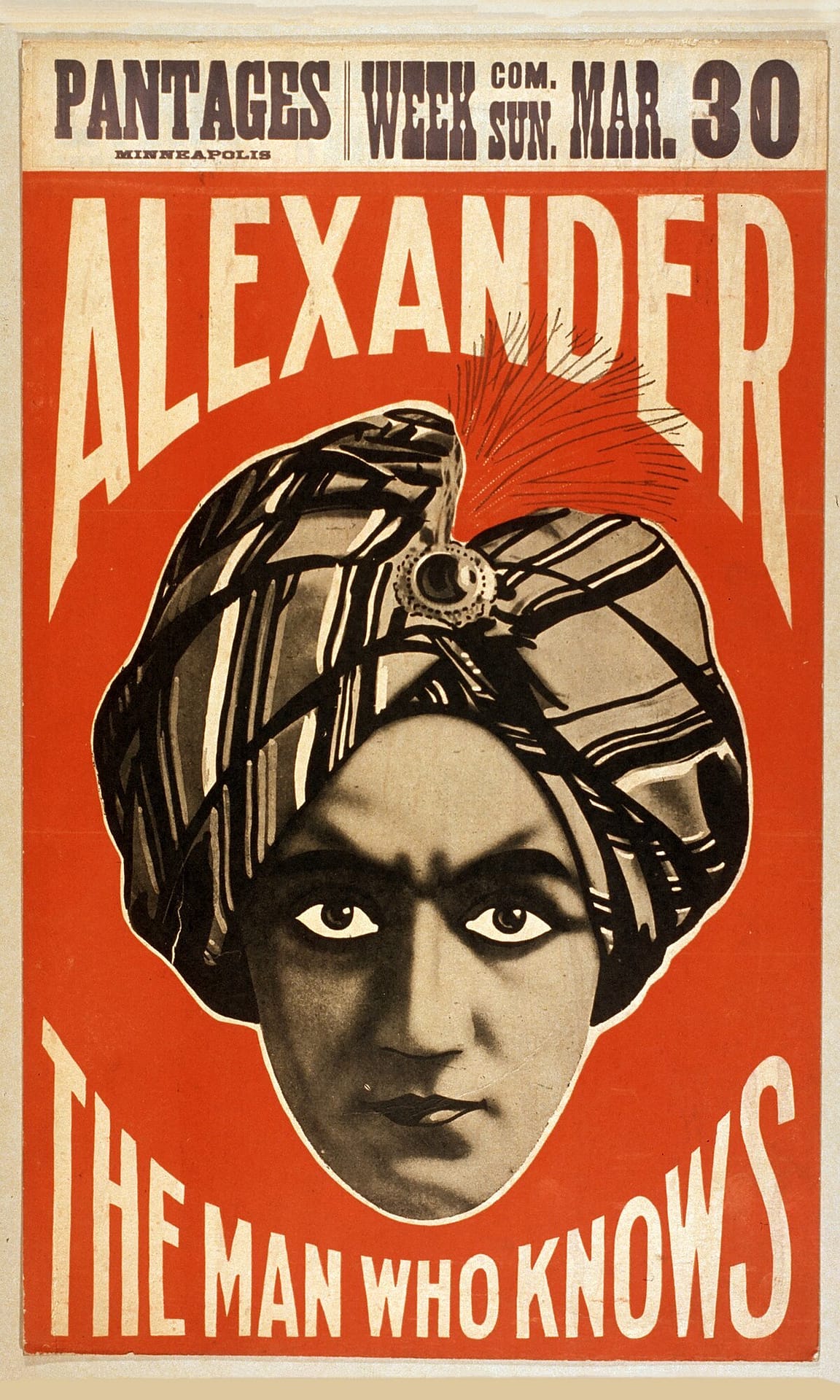
If his methods were borrowed and his technology hidden, his marketing was entirely his own, and arguably his greatest gift. Alexander understood promotion as few performers of any era have. His lithographed posters, with the turbaned head, the hypnotic eyes and the promise to read your life "from the cradle to the grave," are masterpieces of theatrical advertising, and he refined every detail, adding Eastern lettering and darkening his own complexion to deepen the mystery. He was a relentless side-seller too, moving books, crystal balls and mail-order courses through an operation large enough to keep six staff busy despatching orders. He moved easily among the famous, counting Pantages, the showman John Considine, the screen idol Rudolph Valentino and the actress Clara Bow among his circle, with Marion Davies, Harold Lloyd and Jackie Coogan also among his acquaintances.
The Author and Prophet of "New Thought"
In his early forties he turned author, writing under the name "C Alexander." In 1921 he published The Life and Mysteries of the Celebrated Dr Q, and he ran his own imprint, the C Alexander Publishing Company of Los Angeles, which issued his pro-spiritualist and "New Thought" material, including the multi-volume Inner Secrets of Psychology and instructional booklets for his Crystal Silence League. He liked to close his shows with a prediction of his own: "someday psychology will be taught in schools," a line that drew open disbelief from audiences who could not imagine such a thing.
The Other Life
Offstage, the record reads like pulp fiction, and his biographers cannot even agree on its basic facts. They disagree most strikingly on his marriages: David Charvet documented seven, sometimes to more than one woman at a time and once to the same woman twice; Darryl Beckmann counted eleven; and in a 2006 interview Alexander's own son put the figure at fourteen. He broke out of a jail in Oklahoma in 1906 and later served time in McNeil Island Penitentiary in Washington state, from which, the story goes, he engineered his release by bribing a guard to have him moved to the infirmary, where a doctor, perhaps also bribed, duly certified him as terminally ill. He stood trial for attempting to extort fifty thousand dollars from the oil magnate G. Allan Hancock. He ran bootleg liquor by speedboat from Victoria across the Queen Charlotte Strait to a beachfront retreat near La Push, where he is said to have hosted wild parties and private seances for wealthy clients. He is reputed to have admitted killing four men, and he accumulated a substantial FBI dossier. His life, as the original man of mystery, was anything but dull.
Fortune and Retirement
And it made him extraordinarily rich. Reliable accounts put his career earnings at around four million dollars, a colossal sum equivalent to tens of millions today, and every one of his biographers agrees he was the highest-paid mentalist in the world at his peak. He dominated the stage for the best part of a decade before retiring around the mid-1920s, in his early forties, reportedly the richest man in vaudeville. Retirement returned him to his first loves of hunting and fishing, alongside a photographic sideline of a more private nature that, by his own account, earned him a further small fortune. He died on 5 August 1954, aged seventy-four.
Legacy
Alexander's influence outlasted him in three distinct ways. His lithographed posters remain among the most prized images in all of magic, collected and exhibited as works of art in their own right. His professional identity itself was inherited: after his retirement the performer Leon Mandrake acquired much of his material and later adopted the Alexander name. And his sealed-question act lives on as the direct ancestor of routines still performed today. Audiences who watch a modern mentalist answer questions he could not possibly have seen are watching, at one remove, the act Alexander perfected a century ago. His life was so lurid that it is widely cited as an inspiration for the 1947 noir Nightmare Alley. He remains the template for the mentalist as both miracle-worker and mystery.
Frequently Asked Questions
Who was Alexander, "The Man Who Knows"?
Claude Alexander Conlin (1880-1954) was an American stage mentalist who became the highest-paid mind reader of the vaudeville era, performing a question-and-answer act in turban and robes under the billing "Alexander, The Man Who Knows."
Was Alexander a genuine psychic?
No. He never possessed psychic powers. His act combined cold-reading psychology learned among spiritualist mediums with pioneering concealed electronics and superb showmanship, although he marketed himself as the genuine article.
How did Alexander appear to read minds?
He combined the psychology of cold reading with hidden technology, including earpieces concealed in his turban and wired stages that fed him information gathered before and during the show, all dressed in theatrical mysticism.
How wealthy did he become?
His career earnings are usually put at around four million dollars. Every biographer agrees he was the highest-paid mentalist in the world at his peak in the 1920s, and he retired reportedly the richest man in vaudeville.
Is Alexander still influential today?
Yes. His sealed-question act is a direct ancestor of routines still performed by modern mentalists, and his posters remain among the most collected images in magic.
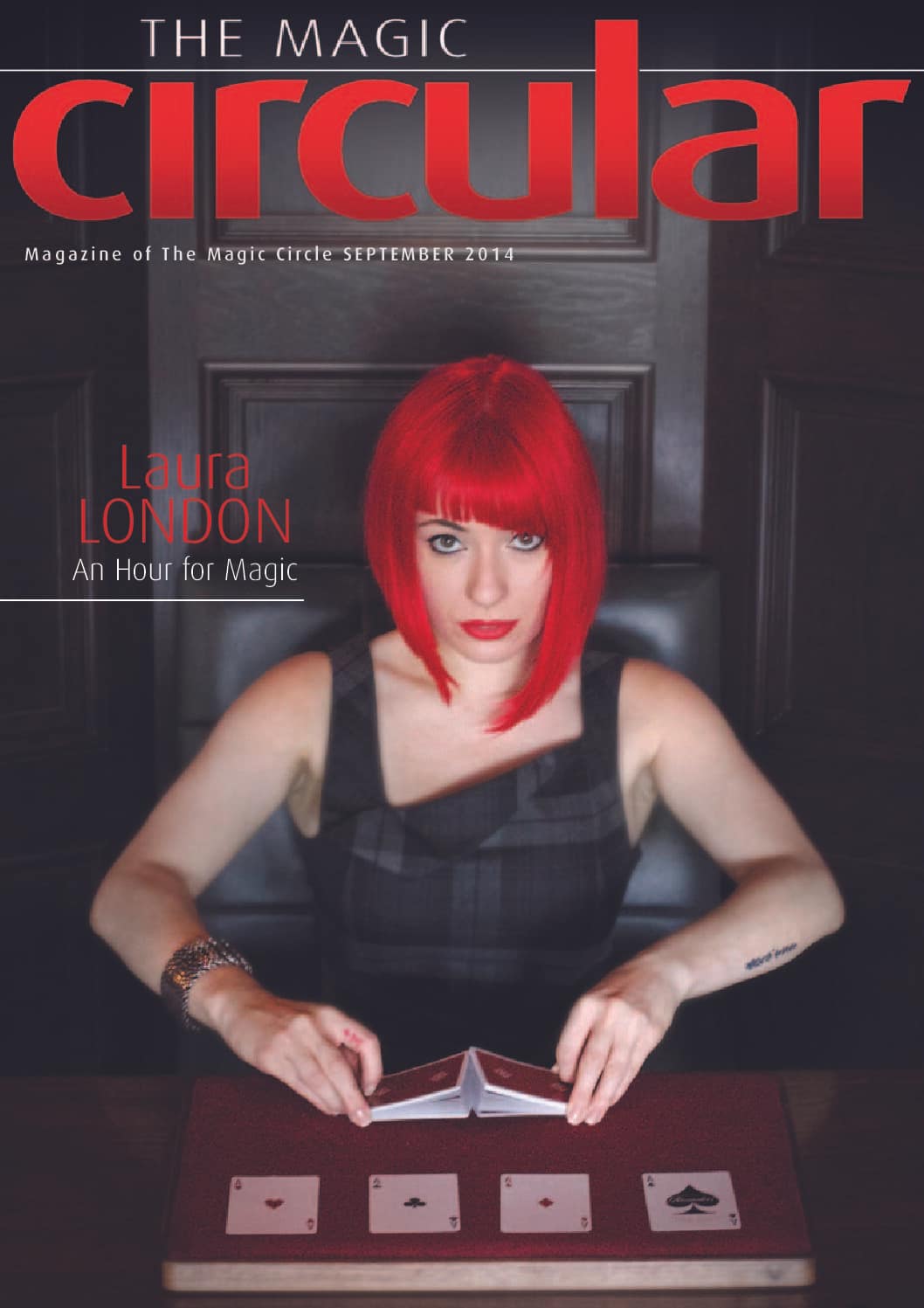
From The Magic Circular
This profile is adapted and expanded from Roberto Forzoni's original feature in The Magic Circular, the journal of The Magic Circle, September 2014.
Sources & Further Reading
- Charvet, David & Pomeroy, John. Alexander: The Man Who Knows (Mike Caveney's Magic Words, 2006).
- Beckmann, Darryl. The Life and Times of Alexander (Rolling Bay Press, 1994).
- HistoryLink.org, "Conlin, Claude Alexander (1880-1954)."
- Alexander (C Alexander Conlin). The Life and Mysteries of the Celebrated Dr Q (1921).
The Mind Readers Podcast · Chapter 01 of 09 · 24 min
The Secret Crimes of Alexander the Psychic
Hear the story of Alexander, told by Roberto Forzoni
An original audio series on the legends who read minds. Free to download — one email unlocks all nine chapters, to play here or take with you.
Free. One email. No spam, ever.
Experience Mind Reading for Yourself
Roberto Forzoni carries on the tradition of these great performers, bringing psychological magic and mind reading to events across London and the world.
Check Availability